
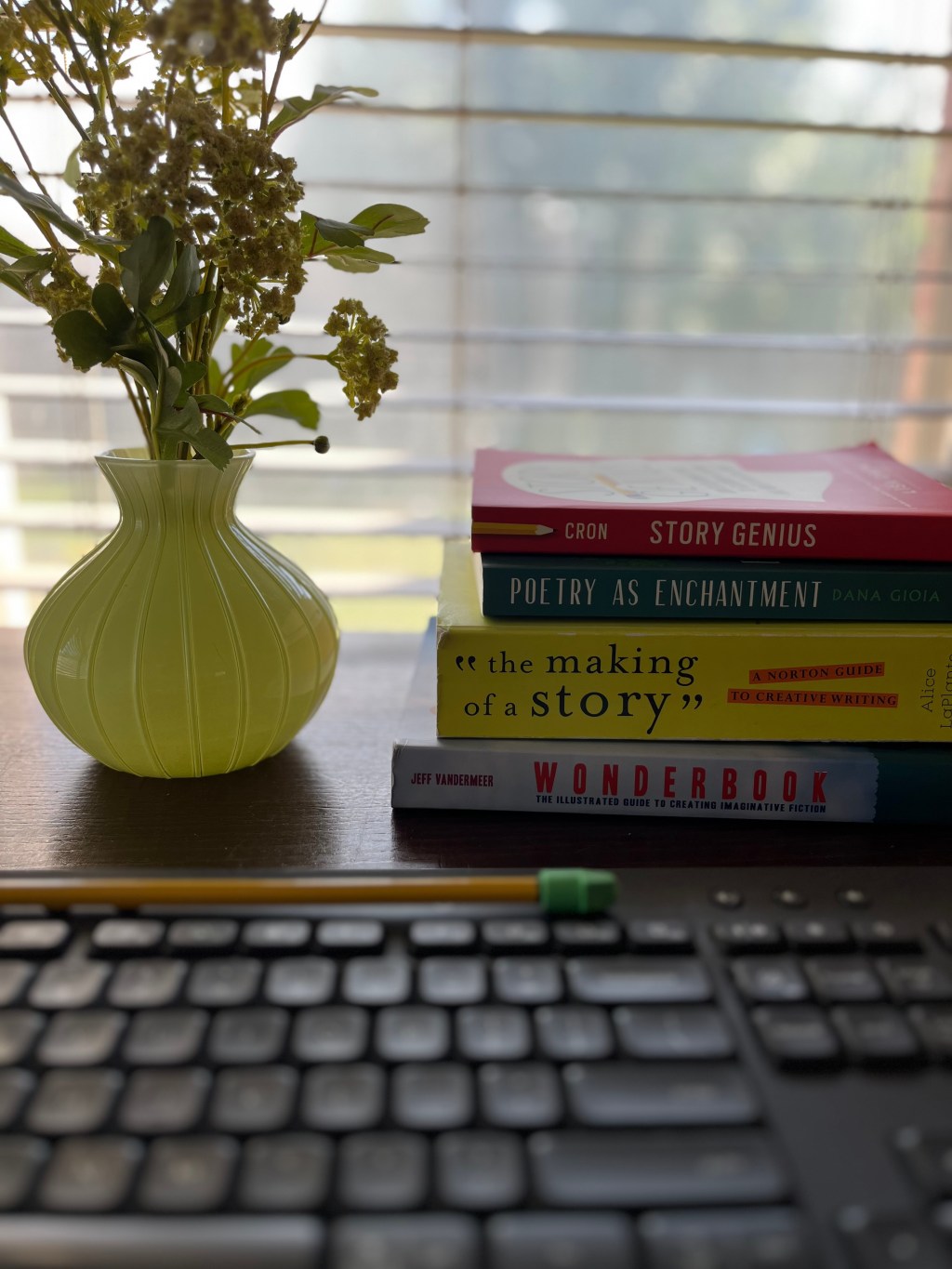
Without further ado, THE LIST (in no particular order, with the exception of #1!)
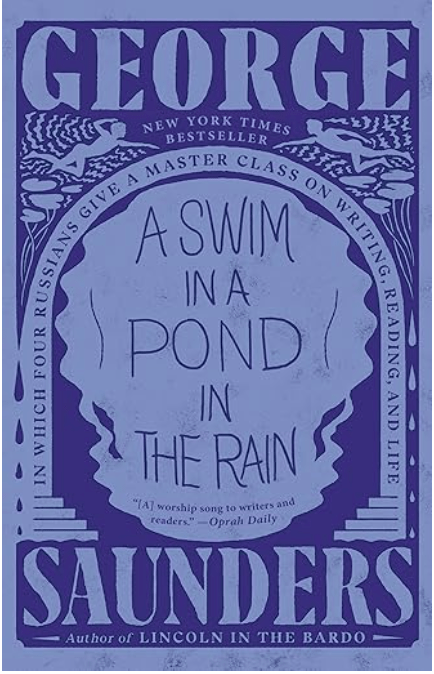
- A Swim in a Pond in the Rain: In Which Four Russians Give a Master Class on Writing, Reading, and Life by George Saunders. Random House, 2021.
I’m currently on my third read-through of this book – which is why it’s first on the list. Each time, the reading experience is like having an illuminating conversation with a writing mentor who’s funny and thinks deeply and who’s rooting for you.
In A Swim in a Pond, Saunders takes seven brilliant Russian short stories and investigates what makes each of them tick, then explores how we can apply what we’ve discovered to our own stories. But he’s never prescriptive, never formulaic. Here’s a taste of the general tone of this book:
“I like what I like, and you like what you like, and art is the place where liking what we like, over and over, is not only allowed but is the essential skill. How emphatically can you like what you like? How long are you willing to work on something, to ensure that every bit of it gets infused with some trace of your radical preference? The choosing, the choosing, that’s all we’ve got” (348).
Be prepared, after reading, immediately to dash off and write.
2. Wonderbook: The Illustrated Guide to Creating Imaginative Fiction by Jeff Vandermeer. Abrams Image, 2013.
Opening Wonderbook feels like sliding down a rabbit hole into story wonderland. Unlike most books on writing, it’s filled with images – cartoons, funky diagrams, paintings – so it engages both the left brain and the right brain, nurturing world-building creativity and structure at the same time.
In the chapter on “Narrative Design,” for example, Vandermeer writes, “My rule of thumb is that given Plot, Structure, and Style, one of them has to tap out and play for Team Mundane. The reader needs something to hold on to while the author experiments with something that excites them” (154).
This idea is accompanied by three images: 1) a stone tunnel with a series of circular walkways all the way down; 2) backlit shapes that might be fungus or lizard feet; and 3) a jellyfish (I believe, though it might also be a cabbage leaf).
This book also features essays and ruminations by other authors. One of my favorites, in the chapter on worldbuilding, comes from Charles Yu: “Some of the big-box stores (Trauma Depot, Orchard Hardware, and Experiential Supplies) sell gallon jugs (or even big, industrial, five-gallon drums) of homogenized life experience. Don’t use that stuff” (“On the Synthesis of Minor But Noteworthy Universes,” 237).
Be forewarned, though: some of the images are (intentionally!) disturbing, with or without hints of violence.
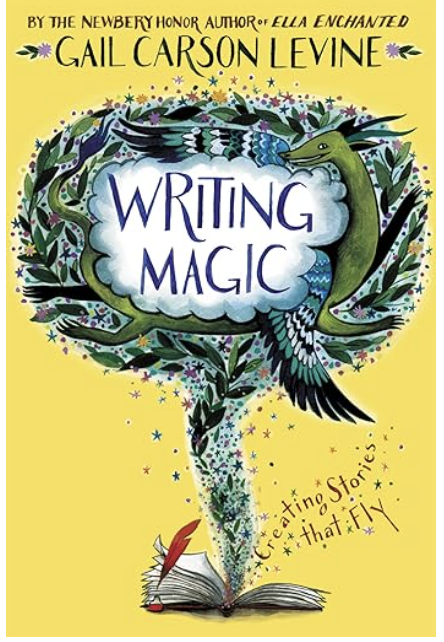
3. Writing Magic: Creating Stories that Fly by Gail Carson Levine. HarperCollins, 2014.
Gail Carson Levine is the author of Ella Enchanted, among other stories, and her target audience is the same for this book, which makes it great for budding storytellers. But Writing Magic isn’t limited to a middle-grade audience – it’s helpful for writers of any age, containing some of the best explanations I’ve read on different aspects of storytelling, with an engaging, unpretentious tone.
Plus, it’s practical. Take the chapter on point of view, titled “Who Am I?,” which begins, “when you read a story or book, you see the events through someone else’s eyes, hear them through someone else’s ears. You feel the fictional world through someone else’s fingers, smell it through someone else’s nose.” (66). It’s a very small step from that explanation to writing a scene in a concrete way.
Levine also includes multiple writing prompts with each chapter. For the point-of-view chapter, she describes several high-drama situations and encourages writers to spin out a scene from different characters’ perspectives. (For the specific prompt, you’ll need to buy the book!)

4. Story Genius: How to Use Brain Science to Go Beyond Outlining and Write a Riveting Novel by Lisa Cron. Ten Speed Press, 2016.
The premise of Story Genius is that we all read stories to learn how to solve problems, so the reason we keep turning pages is to find out how characters work through their problems. And, according to Cron, characters’ difficulties are rooted in their past. To work through their problems, they need to change not just their external world, but something inside themselves, so “the events in the plot must be created to force the protagonist to make a specific really hard internal change” (28).
If writers miss the importance of the character’s past on the story, Cron argues, their book will eventually fall apart. She suggests a specific, step-by-step method for keeping the external events and the internal change of the character interlocked and moving forward throughout your story.
Hint: you’ll want a stash of notecards on hand for this book, and possibly, as in You’ve Got Mail, a “bouquet of newly sharpened pencils.”
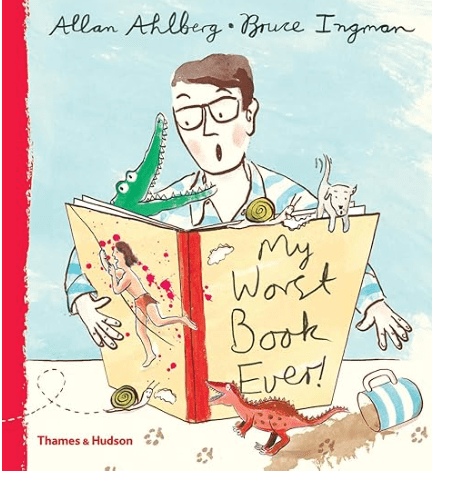
5. My Worst Book Ever! by Allan Ahlberg. Thames & Hudson, 2018.
Yes, this is a picture book, and no, it isn’t on this list by mistake!
This is an honest, funny, and succinct look at the writerly life, and I’ve included it here because who couldn’t use that kind of company on this journey?
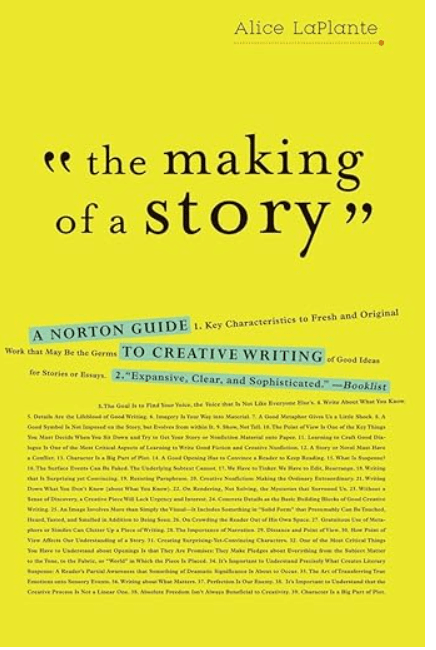
6. The Making of a Story: A Norton Guide to Creative Writing by Alice LaPlante. W.W. Norton & Company, 2007.
If you want the equivalent of a college course on creative writing, this is the book for you. Chapter topics include “What Is This Thing Called Creative Writing?,” “Why You Need to Show and Tell,” and “The Plot Thickens.” For each topic, LaPlante includes thought-provoking and voicy examples – some written by students in previous courses, some published. She also includes reflection questions and an abundance of writing exercises.
In the chapter, “What is This Thing Called Creative Writing,” for example, LaPlante gives this advice: “One of your main jobs, throughout your writing life (it doesn’t necessarily come easy, or soon, or ever stop changing) is to discover and/or develop . . . voice. It might not be the same as your speaking voice. It is the unique way you have of expressing yourself in the written word, and the more straightforward and honest you are in the words and sentences you put on the page, the more your voice will shine through. For the most part, this means forgetting about using big words, complex sentence structures, ornate language, unless that comes naturally to you” (37).
This explanation is followed by a piece by Joan Didion and one by Denis Johnson. And here’s just one of the writing prompts for the chapter: “‘Scan back over your life and think of things that have stuck in your mind, but no no obvious reason (no births or deaths or other ‘important” moments) . . . Don’t try to explain why they stuck with you, or interpret the meaning of them. Just put your reader there.”
This book helped me work on aspects of the writing craft I hadn’t considered before, access more creativity, and sharpen my voice. It does require an investment of time, but in my opinion, that’s time well spent.

7. The Emotional Craft of Fiction: How to Write the Story Beneath the Surface by Donald Maass. Writer’s Digest Books, 2016.
Maass, a prominent literary agent, draws from his experience of reading hundreds of successful – and not-so-successful – stories in a quest to answer this questIon: why do readers engage with some stories and not with others?
He gives the answer up front, so this isn’t a spoiler: successful stories, he argues, allow readers to take their own emotional journey as they read.
So, how can a writer invite readers along on a character’s journey? Maass describes a wealth of ways to build this path, from big-picture themes to micro-level technique. In a chapter on describing character emotion, for example, he writes: “Be obvious and tell readers what to feel, and they won’t feel it. Light an unexpected match, though, and readers will ignite their own feelings, which may well prove to be the ones that are primary and obvious” (23).
He includes exercises for each section that help writers apply these ideas to a current (or future) work in progress.
Note: Kleenex not included, but advisable, because writing in this way will take you, the writer, on an emotional journey too.
 Helen Dent, Author
What are your thoughts?